

Some months ago in London Armando told us going to the jungle in Perú is an adventure. We had no idea but we were both very keen to go there anyways.

The dense jungle
We now know that Armando was right. Christine and have never been to another place where so many animals can hurt or even kill you. Luckily we had an amazing guide with Carlos, who was able to identify all the animals and plants, which we saw. He also told us a lot about the local people and their habits. There are also uncontacted tribes in this part of the Amazon where we were going. They rarely show themselves and there are stories that they kidnap women, which are never seen again.

This is our great travel group – we were joined by Whitney from LA and Chris from the UK
We started our 8-day trip in Cusco, driving over the Andes on a bumpy road to reach Manu National Park. We entered the park at Acjanaco (3,500 meters above sea level) and then descended through the cloud forest.

The cloud forest
In these huge mountains full of trees we saw the national bird with the funny name Cock-of-the-rock.
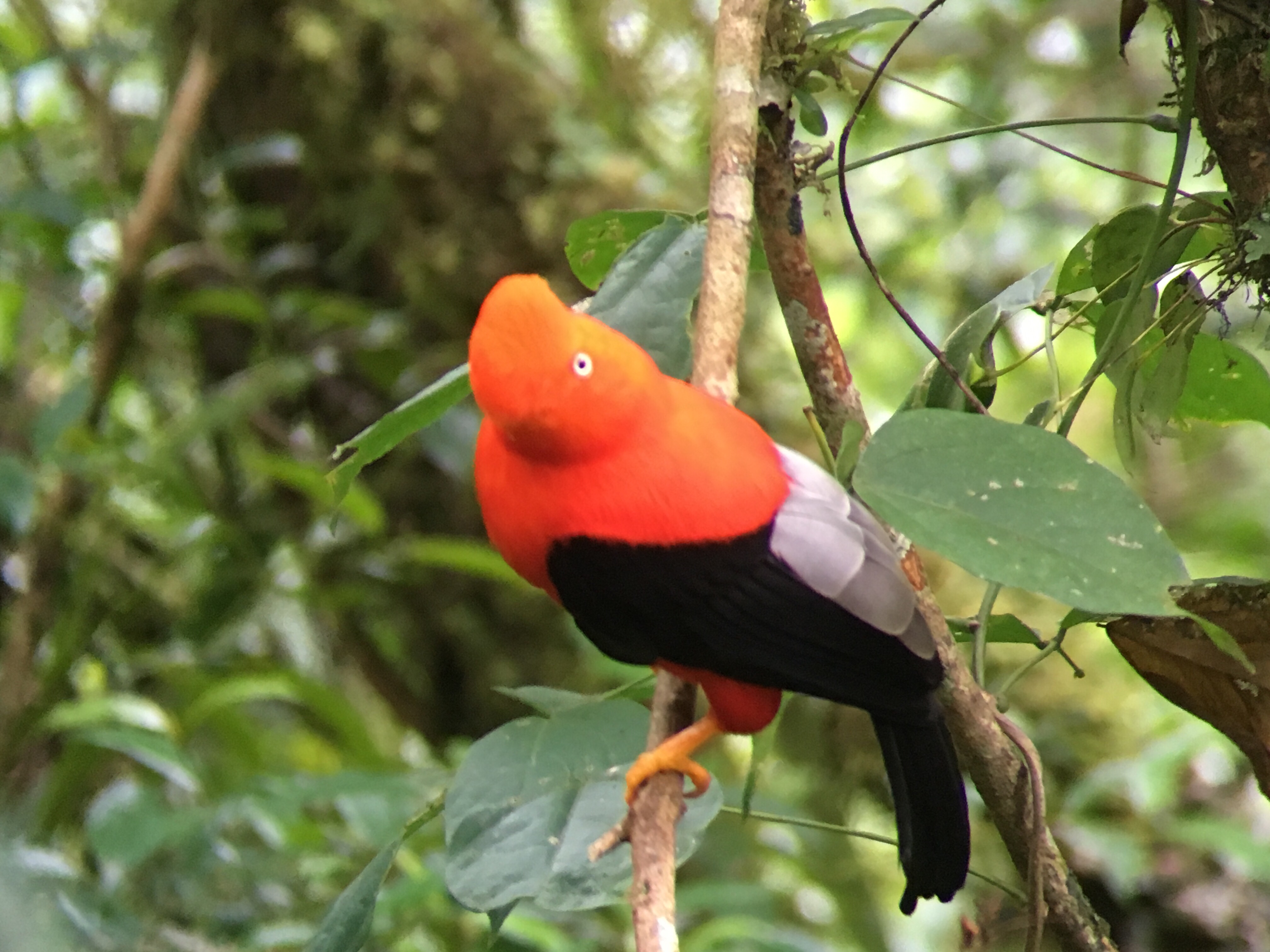
A Cock-on-the-rock on a branch
The Manu National Park is famous for its huge diversity of plants and animals. For example, there are over 1,300 species of butterflies (something for you, Philip G. 😁). However, we quickly realized that it is very difficult to spot animals as the forest is very dense and you need a trained eye and some time to discover them.
 Search image – what and how many animals do you see on the picture above?
 Camouflage is everything if you don’t want to be eaten
 Christine and I watching out for animals, well covered against the mosquitoes
On our second day we collected our rubber boots (not only against the mud but also against snake bites – only the deadly Bushmaster snake can bite through 😬) and went on our boat (the fastest way to travel).
 The river Rio Madre de Dios – below is Atalaya where we boarded our boat
We enjoyed our first bit until we learned what a rain forest really is. It poured cats and dogs and we were in the middle of a thunderstorm. We had to stop for almost an hour because our boat driver and our navigator were not able to see the rapids in the heavy rain. Luckily, we made it safely to our second lodge, but we were cold and soaked through when we arrived.
In the evening we went on our first night walk and it was very exciting, not only because we were in the complete dark with only our torches but especially because of the many animals we spotted. In the evening walks (we did four in total) we usually saw a lot of insects, spiders, one snake, some frogs and toads. Additionally we heard a lot of croaks, chirps, tweets and howlings (from the howler monkeys).
 Night walk
 A Three-striped poison frog
On the third day we went into the reserved zone of the park and registered ourselves at the ranger station. It took us another six hours to reach our lodge, which was managed by the local Machiguenga tribe.
 These were our beds – the mosquito nets were much appreciated
The lodge was nice, the only „challenge“ was the shared bathroom in another house where we brushed our teeth next to a banana spider or were approached by flying cockroaches while we showered. And we always had to put on our rubber boots to walk the 15 meters to the bathroom because of the possibility of snakes on the ground.
We started our first day walk to the jungle right from the lodge into a primary forest (untouched by humans). There were so many beautiful trees and plants and we often stopped to take pictures or to listen to Carlos‘ descriptions. The trees were imensely high and tree trunks so large that we looked like dwarves next to them.
 On the following days we did many walks, went on observation platforms and used our boat to reach even more remote parts of the jungle.
 The bridges were also challenging
 We usually started early, that morning we left the lodge at 4:30 am to see the Giant Otters
We saw so many animals (see separate blog contribution on the animals we saw), even though we came at the beginning of the rainy season where sightings especially of mammals are much rarer. Our most important sightings were the endangered Giant Otters, which we observed from a boat, nine out of the 15 endemic species of monkeys, a tame tapir, two snakes, several toxic frogs, numerous macaws, an ocelot and a huge stick insect.
 Introducing Manolo, the playful tapir
On our way out of the reserved zone we had our highlight: we saw a Jaguar on the riverbank. It is generally rare to see a Jaguar and it is very unlikely to see one at this time of the year. What was even more special was that it was a black Jaguar. Sightings of a black one are extremely rare and we heard that only people from the local tribes saw some. When we checked out at at the ranger station we reported our Jaguar-Panther with the coordinates, doing our scientific bit.
On our trip back we started at 4:30 am and took the boat for three hours, then changed to taxis (with no seatbelt, driver with flip flops, driving over broken bridges) for one hour until we reached another large river, which we crossed on a small boat.
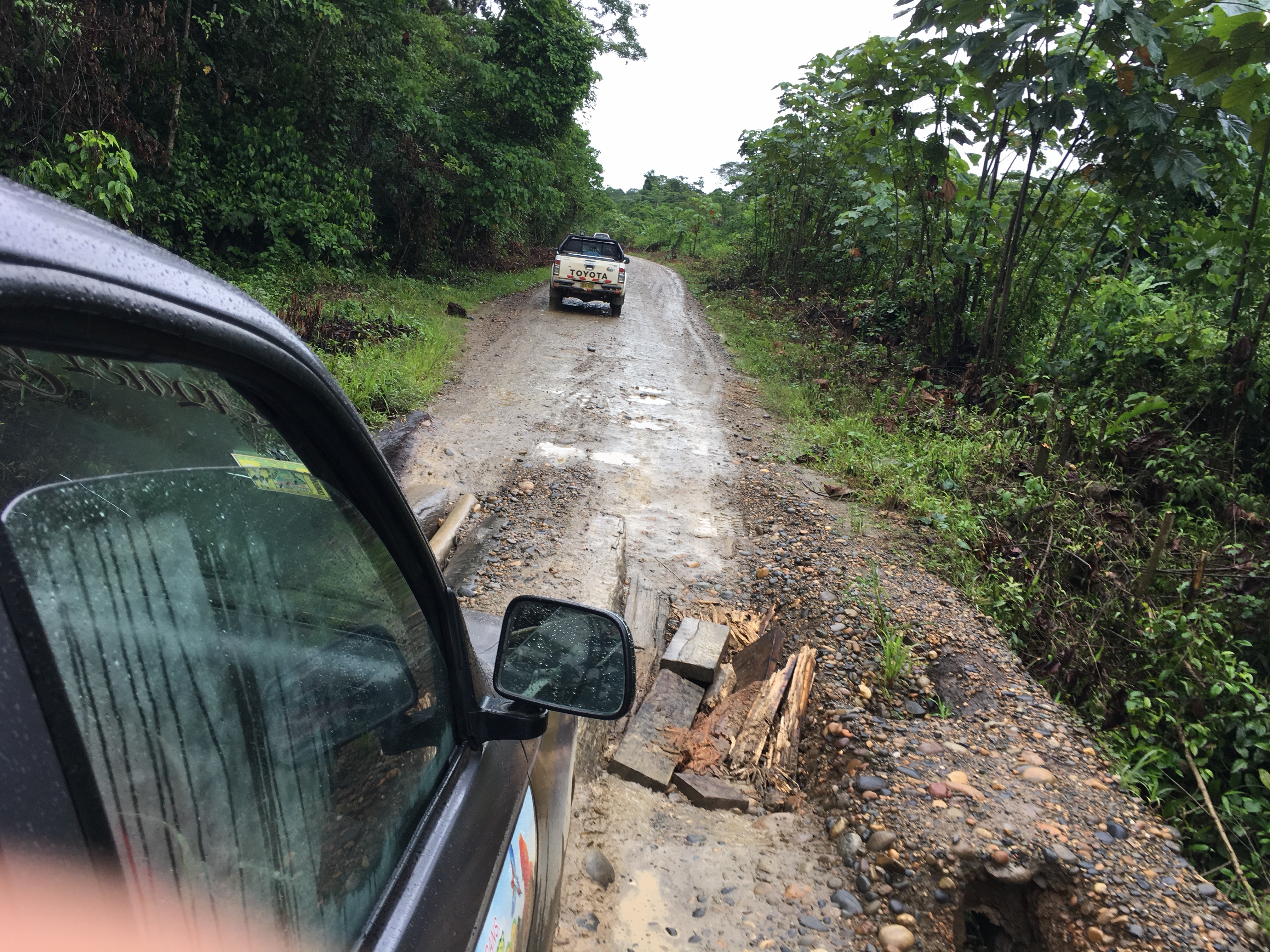 Driving over brocken bridges
On the riverbank was our car which brought us back over the Andes (highest point over 5,000 meters above the sea) where we reached Cusco at 6 pm. We were tired but happy that we survived the jungle.
 Our last lunch in the Andes

 Erst einmal weg...
I love it!! everything!! but be sure I will only see the jungle through your photos! hahaha Diviértanse muchísimo!!! Besos para los dos!!!
LikeLiked by 1 person
Yes it was an amazing adventure. But maybe you will see it with your own eyes some day, living on the doorsteps to the jungle. 😉
LikeLike
What a beautiful sunset pic! And don’t forget we also heard the snoring birds on our nighwalks… brrrrrrrrrrrr!
LikeLike