

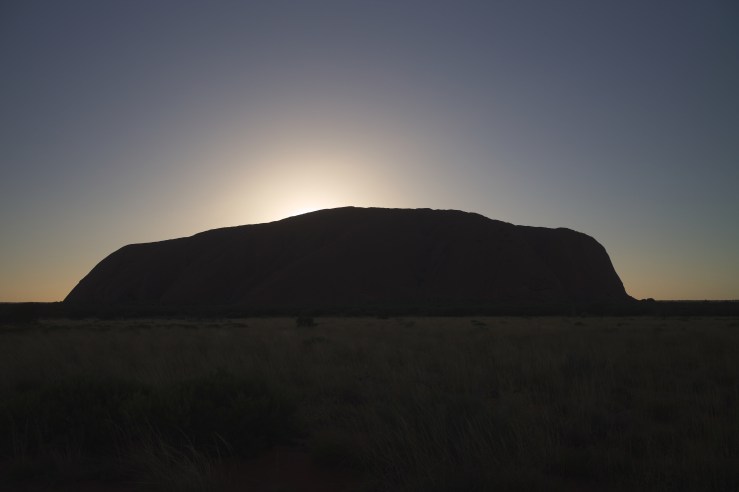
What we came for – the rock in the middle of nowhere.
On our way accross Australia we stopped for five days in the middle of the notorious Australian Outback. We heard a lot of stories about the boiling heat and the poisenous animals in the bush, which did not scare us too much after our trip to the jungle.
Once we arrived at the airport of Alice Springs it started great. My backpack was taken out by the police dog, he smelled something. After an intense search and investigation on camera, they let me go. The dog smelled the plastic bags which we used to pack our things safely. Apparently many drugs are also packed in plastic bags, which is why the dog picked my bag.
Then we went to the car rental desk where the young man told us that there is no insurance if we drive the car by night. It is way too dangerous, as we would not be able to see kangoroos who jump into the car lights. And they can jump seven meters in one leap. A local also told us to be very careful when crossing or taking over road trains, the huge trucks with two trailers. Prepared and confident we started our way to our first destination: Uluru (or Ayers Rock) the world famous rock in the middle of the outback.
We drove for four hours straight, we did not really use the steering wheel. Once we arrived at our lodge we were not impressed. All of the hotels near Uluru (from budget to expensive ones) are managed by one company and it seems that their monopoly pays off – at least for them. We got a room with two bunk beds in the cheapest hotel, but it was still very expensive. Nevertheless, we had to stay there as those were the only hotels in miles.
As the temperature was too hot during the afternoon, we usually drove to Uluru for the sunrise and came back for lunch, then leaving again in the late afternoon to see the sunset. There are designated areas for sunrise and for sunset and the places fill quickly up with tourists so that half an hour before the spectacle the best spots are already taken. We also did many pictures of the rock and were fascinated by the change of colour: Before the sunrise Uluru is a dark rock. Once the sun comes up the colour changes into a dark red which gets brighter by the moment. It was beautiful and we woke up early twice to see the spectacle.

Uluru at sunrise. On the left side you can see Kata Tjuta in the back.

Closer shot of Uluru. The red coloured rocks, the yellow grass and the green bushes formed a beautiful picture.

Christine in front of Uluru. This is a photo from the sunset, so it’s from the other side of the mountain.
After the sunrise we did some walks around the rock, learning about the traditions of the local Aboriginee tribe, their stories and how they used the rock in ancient time. Uluru is sacred for the, thus they don’t like you to climb it. Uluru was given back to the local tribe by the government some decades ago, but interestingly we could not see many locals working in the facilities. Even the ranger is a white Australian, although he claimed that he learned a lot from the locals.
A very spectacular sight was the light installation “Field of Light” by Bruce Munro. To experience this special art installation you have to get a bus from your hotel which brings you to the field. The installation is called Tili Wiru Tjuta Nyakutjaku or ‘looking at lots of beautiful lights’ in local Pitjantjatjara and is a garden out of 50 000 lights in front of Uluru (although we were not able to see Uluru). It was a bit strange to walk through the dark night with no strong lights (deadly snakes!!), but hey, everyone else did, so we thought it’ll be fine. The installation is there for a limited time. If you can make it before December 2020 then I strongly recommend to check it out (Website).

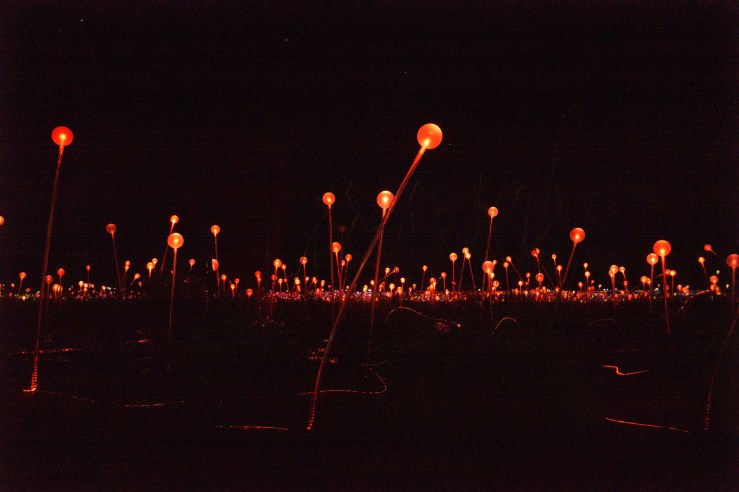
The field of light from Bruce Munro.
There are also a few large rocks nearby called Kata Tjuta. We explored those rocks on a hike called Valley of the Winds. We loved the views and the scenery and that we were almost alone after a while. The area gets very hot during the early afternoon so the rangers close the treck after 11 am. Fortunately, we started early and were back at the car at that time.
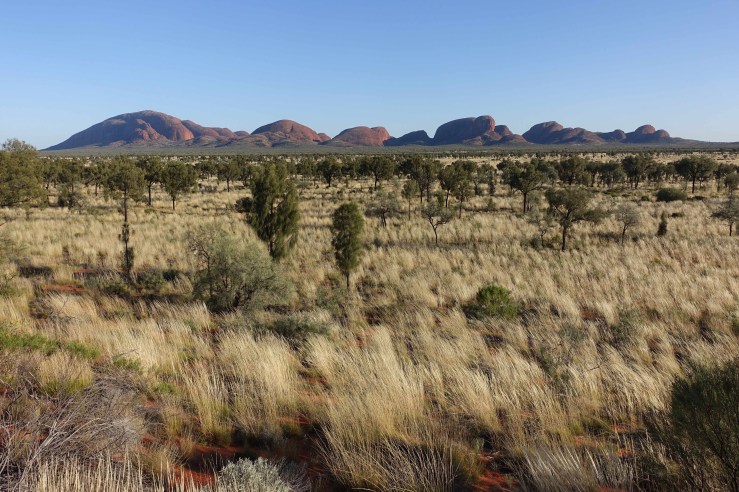
Kata Tjuta from the distance

This is the Valley of the Winds. There were many flies around, targetting the eyes of the hikers. The net around the face was one of the best investments on this trip.

View from the hike – Kata Tjuta from the other side.
We then left the region to drive to Kings Canyon, the place with the famous Rim Walk hike. We left early in the morning (again) to see the sunrise from the top of the canyon. It was spectacular to walk on the rim and we took our time studying the fascinating rock formations.

Christine hiking on the rim.

The other side of the rim. A part of the wall broke down recently, which you can clearly see in the middle of the picture.

I am examining the floor. The lines in the rock are a sign that this was once ocean floor.
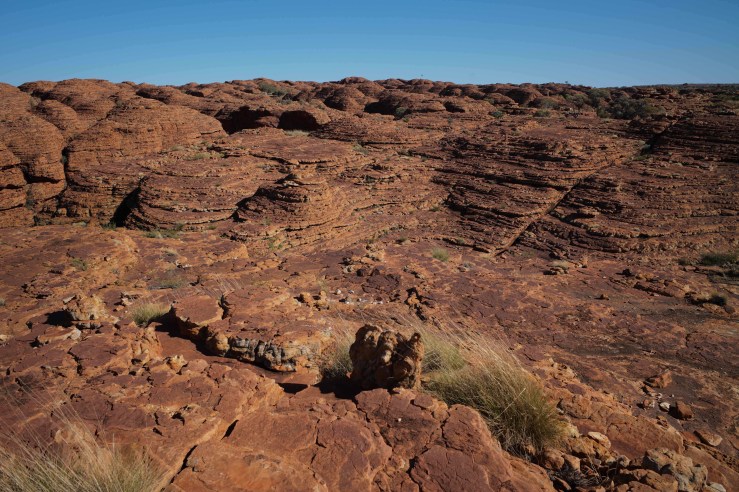
Honeycomb structures at Kings Canyon
In the middle of the walk the path goes down into the valley. The place is called Garden Eden as the ground of the canyon saves the water and is very green with lots of trees, bushes and singing birds. On our way back up to the rim we saw a snake on the canyon wall. A nearby guide told us that this was a King Brown snake, which is apparently one of the 10 most venemous snakes in the world, 50 times more poisenous than a rattlesnake.

Our king brown snake.
Well, everyone with Australia experience told us that there are poisenous snakes but we would rarely encounter one. The snakes would be too afraid of humans and flee before we would be able to see them. 🤨 What stroke us was that the snake was two metres from the path where dozens of people walked and the snake did not care. We decided to apply our „jungle rules“, which means take care on where you step and investigate everything closely before you touch it (a stone or a tree branch).
In the hot afternoon we drove back to Alice Springs. Christine and I did not like the city at all. We were told that there are a lot of robberies in the city and that especially car windows are at danger of being brocken. We thought that they exaggerate but we saw more brocken car windows in those two days than we have seen in all our lives. If you want to go there, make sure you park it safely overnight.
On our last day we did a roadtrip to the West McDonnell Ranges. They are famous for mountain ranges and the waterholes, where many birds and other animals come to drink. We were very lucky to have seen Rock Wallabies, who were hiding in the rocks. We had a lovely last day in the Outback before we boarded our next flight. Next stop: Perth.
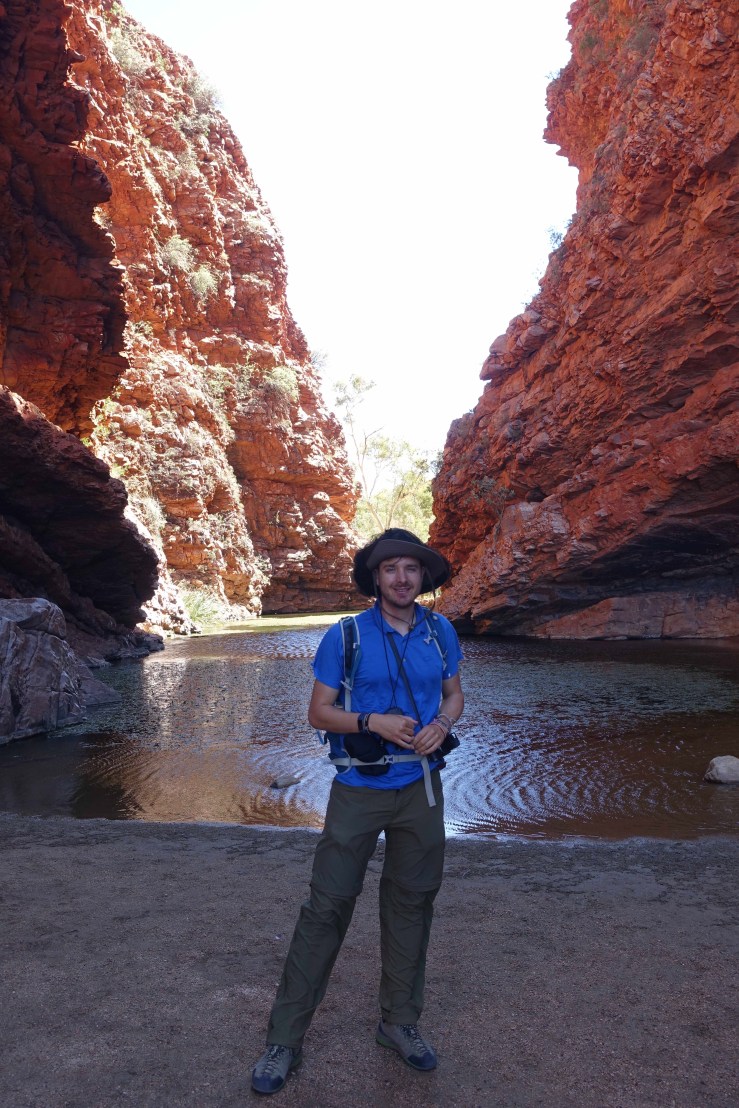
I am standing in front of a waterhole.

The ranges from the rim – you can clearly see different layers of rock in the middle of the picture.
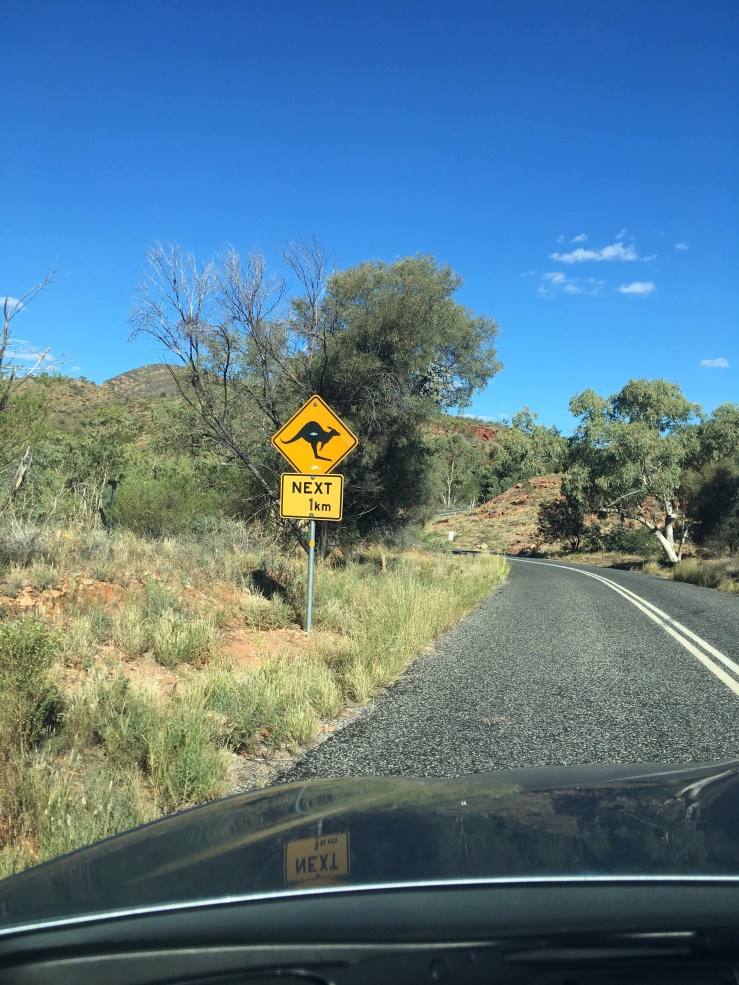
The road was full of wildlife – not. We did not see any kangaroos in the outback, but we still had a chance in Western Australia.

 Erst einmal weg...